
“I haven’t got capacity for that right now.”
Everyone says it, and it sounds like a diary problem. Too much on, not enough hours.
It’s almost never a diary problem.
What people are probably describing is this. They are just about holding on to whatever’s going on in their life. They can just about manage today. They probably can’t manage today PLUS one more thing. And the one more thing doesn’t have to be big. A new project, a tricky convo, a bit of bad news, a kid off school sick, another form that needs filling in. Anything landing on top of what’s already there gets the same internal response: I’m not sure I can handle that.
That’s a nervous system in survival mode. And a nervous system in survival mode has no capacity spare to do anything except survive. Less ability to cope, to think, to absorb, to plan, to decide etc.
So when people say bandwidth, they’re being far more literal than they realise.
I’ve become properly obsessed with this over the last few years, because I started measuring it. And what I’ve found has changed how I work and accelerated my results, so I want to share what I’m seeing.
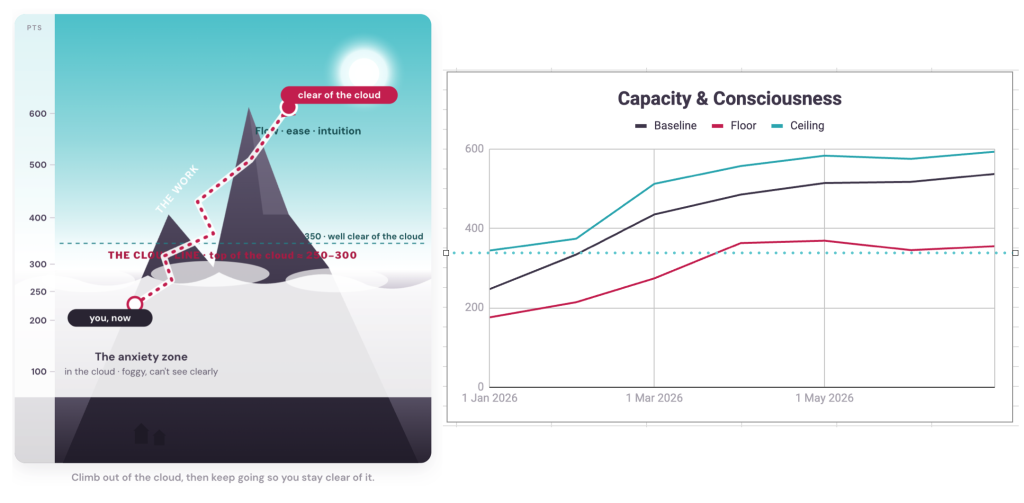
The cloud line
If you know anything about levels of consciousness (David Hawkins’ Map of Consciousness, or Frederick Dodson’s levels of energy) you’ll know that emotional states sit on a scale. Fear, anxiety, doubt, anger and guilt all sit at the lower end of it.
And when I picture that lower end, I don’t picture a number. I picture cloud. ☁️
This will make sense, I promise.
If you’ve ever walked into cloud on a mountainside, you’ll recognise everything about anxiety in it. You can’t see very far. Everything is grey and clammy and close. You go slowly. You test every step, because you don’t know whether the ground will hold or whether you’ll slip on shale and disappear over the edge. You end up stopping a lot, because standing still is the only thing that doesn’t feel dangerous.
Foggy thinking. Can’t see clearly. Can’t move forward. No idea where you’d land if you fell, although you’re fairly certain it’ll be in a pile of yak shit.
I know this one well. I got caught in cloud trekking in the Hindu Kush and there were times when I flat out would not move. I stood there, stuck. I was scared. I cried. I needed someone to come back for me, take my hand and walk me through it 🙈 (thank you, Guy).
Which is, near enough exactly, what someone with severe anxiety needs from a therapist.
Your floor and your ceiling
Here’s the capacity bit.
Your capacity doesn’t sit at one fixed point. It moves within a range. There’s a level you drop to on your worst days and a level you reach on your best ones. Your floor and your ceiling. Your floor has less capacity than your ceiling, which might be obvious, but it’s worth saying out loud because everything else follows from it.
For a lot of people, that entire range sits inside the cloud. The ceiling is mild stress or low level anxiety, with maybe the odd day where they pop their head above it and feel briefly clear. The floor is severe anxiety, sometimes bordering on a disorder, sometimes touching depression. Both ends murky.
Which leads to the two questions that matter: how wide is your range, and where is it sitting?
You can probably answer that for yourself already from what I’ve described. But the thing most people want to know is how to increase their capacity.
The obvious answer is to work on the ceiling. Get more good days. And that does help. A ceiling above the cloud line means you get out occasionally and see the view, and your nervous system gets a proper break rather than a managed one.
The real leverage, though, is in the floor.
Because the floor is where you land on the bad days, and there will be bad days, because life. If your floor is down in the thickest part of the cloud, every bad day drops you back into fog and you’re testing the ground with your foot again. If your floor is above the cloud line, a bad day is still rubbish, but you move through it quickly instead of being dragged down and stuck in it for weeks. You can see a way through.
That’s what real capacity is. A range that sits above the cloud line.
The bit that took me ages to notice
There’s a second thing that happens up there.
While you’re in the cloud you’re not regulated, so you need coping strategies to stay functional. Breathing, grounding, routines, all of it. Every one of those is a job. Another thing on the to-do list. It’s effort spent on staying upright and holding on rather than on living and pushing forward.
The minute someone gets above the cloud line, most of that becomes unnecessary. That’s an entire category of daily work falling off the list, which hands them back even more capacity. It compounds.
What the data showed me
I’ve been tracking clients’ levels of consciousness for three or four years now. Yes, I have charts.
I started doing it because I wanted to know whether the work I do affects someone’s level of consciousness. Was there a relationship between healing and level of consciousness at all? I established a positive one fairly quickly, which meant my next question was: could I bring those changes about faster? Efficiency is my middle name, after all.
What I’ve observed is that when I aim at the floor rather than the ceiling, the pace of change speeds up. I’m now getting people out of the anxiety cloud in two or three months routinely. Not just their floor. Their ceiling too. The whole range relocates.
And when they cross that line, feeling calmer is the least interesting thing they report. They say they’ve got capacity again. That’s the word they reach for, every single time. Then they start doing more epic shit. Bigger projects. Bigger thinking. Because this is what the clear view gives you: not just sight of your own feet, but sight of what’s twenty miles out. They can plot a bigger course, because for the first time the course is visible.
I’ve got a chart from someone who did this work where you can see what happened.
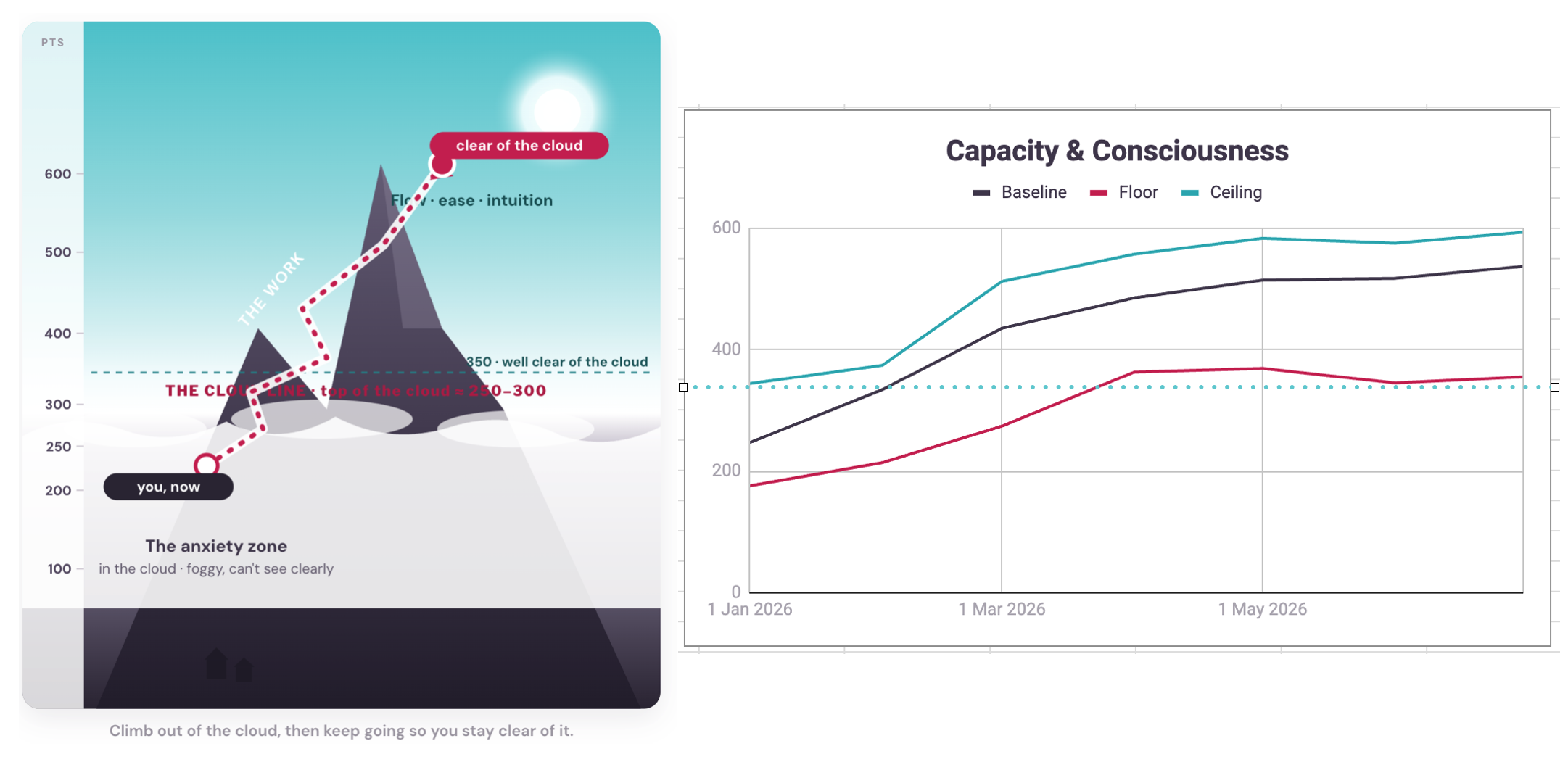
At the start, their whole range sat inside the anxiety cloud apart from a sliver poking above it. Just over three months later their floor was higher than their ceiling had been at the start. Anxiety firmly behind them, and in its place someone much calmer and more grounded, showing up better as a parent and as a business leader.
So what raises a floor?
Almost never the current life problem.
It’s the old stuff. Childhood wounds, inherited family trauma, things they haven’t consciously thought about in decades. That’s what’s sitting at the bottom of the range, holding all the emotional weight down. Clear that and the floor comes up on its own.
You don’t push a hot air balloon upward. You drop the weights over the side of the basket and it rises, because that’s what it was trying to do the whole time.
Practitioners, this bit is for you
If you’re aiming your work at someone’s ceiling, at their functioning, at their good weeks, you’ll get results and those results will be fragile. The first bad week takes them straight down to a floor you never touched.
Aim at the floor. Go after the old material holding it down.
When I started planning my work on that assumption, the results accelerated. That acceleration is the only reason I now believe the model is right. If it were wrong, it wouldn’t have happened.
And honestly? I think this is what’s missing in a lot of delivery models. Not the techniques. The targeting.
Why I keep banging on about it
There is an enormous amount of human capability currently sitting in cloud. Going slowly. Testing every step. Unable to see far enough ahead to commit to anything. We are all operating from a much lower place than we could be, collectively. So we need a lot more people getting a lot better at clearing anxiety properly.
When you’re above the cloud line you don’t need to worry about regulating yourself, because there’s nothing to regulate. That doesn’t mean life stops throwing crap at you. It absolutely does. But when it lands, your first response isn’t “FFS, I haven’t got capacity for this.”
It’s “right, what do I need to do to get through this?”
That’s the difference. And it’s a much bigger difference than it sounds.
If you’re wrestling with anxiety or with a capacity that’s permanently maxed out, I work with people on this in two ways. There’s an anxiety programme that targets anxiety specifically, which is essentially the 1:1 version of my book Clear Your Anxiety. For Good. And there’s The Ascent, which is the one that gets the wilder results, because it targets the floor rather than the anxiety itself. Broader lens, bigger scope, and the whole point of it is getting you above the cloud line.
Practitioners: I train people to work this way. Find out about Head Trash Clearance practitioner training.